
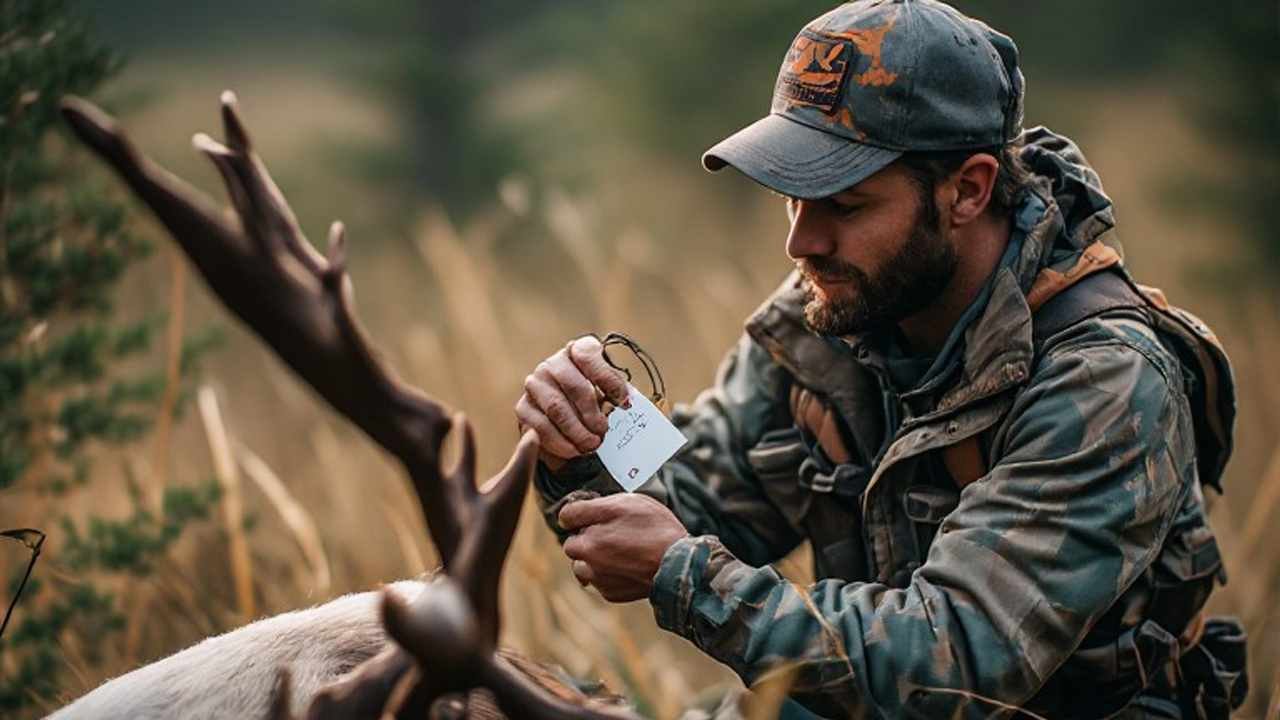
Transporting Harvested Game in Canada: Documents, Tags and Rules
If you’ve ever watched a truck pull away with your moose quarters strapped to the rack while your tag sits in your pocket, you already know why this topic makes hunters nervous. Across Canada, moving a harvested animal is a paperwork exercise wrapped in a legal obligation — and the rules shift the moment you cross a provincial line, change vehicles, or drive toward the U.S. border. The short answer: carry your licence and tag in paper form, keep the tag attached whenever you’re not physically with the carcass, leave the required evidence of sex and species naturally attached, and follow federal rules for birds. Get any one of those wrong and a conservation officer can turn a good hunt into a court date. This guide breaks down exactly what documents, tags, and carcass rules apply so you can haul your harvest home with confidence.
There is no single national transport certificate in Canada. Instead, transport compliance is built from three layers that stack on top of each other: your provincial or territorial licence and tag, the provincial carcass and evidence rules, and — for migratory birds — the federal Migratory Birds Regulations, 2022. Because each province runs its own licensing engine, the safest habit is simple: before you leave home, read your province’s current regulation summary and treat it as the final word. What follows is a practical, province-by-province reference you can actually use at the tailgate.
What “Transporting Harvested Game” Legally Means
Most new hunters think transport rules only kick in when you hit the highway. In reality, the clock starts the second the animal is down. The term “transport” covers moving the animal, transferring it to another person, leaving it at camp, dropping it at a butcher, and shipping it in a container.
The core obligations are consistent across most jurisdictions:
- Invalidate your tag immediately. You typically notch or mark the day, month, and time at the kill site, before the animal moves.
- Attach the tag when you separate from the carcass. If you leave the animal — even briefly — the tag goes on.
- Preserve identification features. Keep the head, sex organs, or other proof-of-identity parts attached until the meat reaches processing or long-term storage.
- Produce documents on demand. A game officer can ask for your licence, tag, and proof of the hunter’s identity.
The reason for the tag-attachment trigger is straightforward. New rules in Ontario, for example, tie the legal duty to whether the tag holder is immediately accompanying the animal. As long as you’re with it and can produce the tag, you can carry it in your pocket. The moment you load it into someone else’s vehicle, leave it at camp, or hand it to a butcher, the tag must be physically attached Government of Ontario.
Tag vs. Seal vs. Licence: Know the Difference
Hunters constantly mix these three terms up, and that confusion causes real charges. Here’s the clean breakdown.
| Term | What it is | Where it appears |
|---|---|---|
| Licence | Your authority to hunt a species or class | Paper licence, Outdoors Card, or online summary |
| Tag | Single-use marker authorizing one animal; must be carried on paper | Printed tag, notched at the kill |
| Seal | A locking/registration device used in some eastern and prairie provinces | Attached to the animal or registered with the licence |
| Transportation coupon | A detachable licence section used to move game | Common in Quebec-style systems |
| Draw authorization | Proof you were awarded a limited-entry tag | Draw confirmation or licence summary |
Practical takeaways:
- Paper is mandatory in most provinces. Ontario does not accept a tag shown on a phone screen.
- Duplicate or altered tags are illegal. Photocopying or modifying one is a serious offence.
- Replacement tags cost money. Ontario charges an administration fee and requires you to surrender a damaged tag first.
- Your province may not use seals at all. Alberta leans on species licences and harvest tags rather than a universal seal.
For a jurisdiction-by-jurisdiction rundown of how these documents differ, the provincial tag and seal breakdown is worth bookmarking before opening day.
Province-by-Province Transport Rules at a Glance
The table below summarizes how the main hunting provinces structure their tag-and-carry requirements. Always confirm against the current-year summary, because quotas, seals, and coupon systems change.
| Province / Territory | Tag or Seal Approach | Key Transport Note |
|---|---|---|
| Ontario | Printed tag + validation certificate | Tag must be notched before moving; attach if separated from animal |
| Alberta | Species licence + harvest tag | Evidence of sex/species attached to same part as tag until processing |
| British Columbia | Basic licence + species licence | Species licence printed on official paper; some species need physical tags |
| Manitoba | Species licence + game tag | Seal or shipping coupon may apply depending on animal |
| Saskatchewan | Wildlife certificate + species licence | Big-game seals and harvest ledgers must be registered/activated |
| Quebec | Licence with transportation coupon | Coupon identifies game during movement; zone rules vary |
| New Brunswick | Game licence + validation sticker | Tagging and validation requirements rather than one universal seal |
| Nova Scotia | Separate species licences/stamps | Physical tagging or registration may be required for deer and bear |
| Newfoundland & Labrador | Big-game licence tied to area/quota | Tagging and licence coupons apply after harvest |
| Yukon / NWT / Nunavut | Licence + wildlife tag or permit authorization | Physical tags, seals, or community authorizations depending on species |
How to read this table: the pattern is that western provinces emphasize species licences plus attached evidence, prairie provinces lean on seals and ledgers, and eastern provinces use validation stickers and coupons. None of them accept “I left it at home” as a defence.
Evidence of Sex, Species, and Class: The Rule Hunters Break Most Often
This is the single biggest transport trap. If your licence is valid for a specific sex or class of animal, the animal must carry natural proof of that sex or class all the way to processing. You cannot surgically remove it, and you cannot substitute a photo.
Alberta spells out the standard clearly: for moose, elk, deer, pronghorn, bison, and class 2 sheep, the evidence of sex, species, and class must stay attached to the carcass until it reaches a permitted food establishment, an abattoir, or is cut and packaged at your residence Alberta Season Regulations.
| Species | Acceptable Evidence to Keep Attached |
|---|---|
| Deer | Testicles/scrotum or udder (plus the fully haired tail for deer), or the head with antlers, or the skinned head |
| Moose / Elk | Sex organs attached to the same leg as the tag, or head with antlers |
| Pronghorn (male) | Complete skull plate with horns intact |
| Class 2 Sheep (male) | Complete skull plate with horns intact |
| Calf Moose (special licence) | Complete head retained with carcass |
| Bear / Cougar | Tag on skin, or tag as with deer/elk/moose if keeping meat only |
Three things this means in practice:
- Deboning is allowed — with a catch. You can debone in the field, but the portion of leg and tendon carrying the tag must still hold the required evidence.
- The tag and the evidence travel together. They attach to the same part of the animal, which makes inspection fast.
- Processing is the finish line. The attachment duty ends when the meat is cut and wrapped for storage, not when you leave the bush.
Ontario uses a parallel system but frames it as “identifying features.” Deer, moose, and elk must keep those features with or attached to the animal until it’s at the butcher or being prepared for storage Government of Ontario.
Tagging Locations: Where the Tag Actually Goes
You can’t just zip-tie a tag to an antler and call it done. Provinces specify exact attachment points.
| Species | Where the Tag Goes |
|---|---|
| White-tailed deer / Elk | Antler or ear (keep the head with the animal) |
| Moose (bull or cow) | One hind leg, with sex organs attached to that leg |
| Moose calf | Lower jaw, left whole |
| Black bear | Through cartilage between the nostrils |
| Wolf / Coyote | Through cartilage between the nostrils |
| Wild turkey | Lower part of a leg |
If you’re planning a multi-province trip and want the logistics sorted before you leave, mapping your route with the cross-province hunting road trip planner keeps your documents and carcass handling consistent from border to border.
Migratory Game Birds: Federal Rules You Can’t Opt Out Of
Waterfowl and other migratory game birds fall under federal law, not provincial. That means the rules travel with you across every border in the country.
Under the Migratory Birds Regulations, 2022, you must not possess or transport a non-preserved migratory game bird unless at least one fully feathered wing or the fully feathered head stays attached so officers can identify the species. You also must store the birds so each one can be counted and identified Justice Laws Website.
The labeling rule is just as strict. When a bird leaves your possession, it must be labelled with the hunter’s full name and contact info, the date taken, and the permit number — signed by the hunter.
Fast facts on migratory bird transport:
- Permit required. A valid Migratory Game Bird Hunting Permit with the Canadian Wildlife Habitat Conservation Stamp must be carried, in physical or electronic form, whenever you’re hunting or holding unpreserved birds.
- Cost. The permit runs $17.00 plus tax, which includes the $8.50 stamp.
- Transporting for a friend. You can move a partner’s birds if they were taken legally; if the harvester isn’t in the vehicle, unpreserved birds need a label.
- One label, many birds. A group can share a single label listing each bird’s information, placed on or in the package.
The federal FAQ on migratory game bird transport confirms these requirements and is the cleanest reference Canada.ca. If you want the human-readable version of the rules, that page is your starting point.
CWD Carcass Restrictions: Don’t Move a Whole Carcass Into a Clean Zone
Since 2000, chronic wasting disease (CWD) has reshaped how hunters move deer-family animals. The prion concentrates in the brain, spinal cord, and lymph tissue, so many jurisdictions now restrict whole-carcass movement to slow the spread.
| Allowed to Move | Usually Restricted / Banned |
|---|---|
| Cut and wrapped meat (commercial or private) | Whole carcasses from CWD areas |
| Quarters with no spinal column or head attached | Brain or spinal tissue |
| Boned-out meat | Skulls with tissue attached |
| Hides without heads | Any part retaining lymph nodes |
| Clean skull plates with antlers | Unprocessed heads |
| Antlers with no tissue, finished taxidermy | — |
What this means for transport: if you harvested near or inside a CWD management area, you may be legally required to leave the high-risk parts behind at the kill site, quarter the animal, and only move low-risk portions. Some provinces also restrict moving deer and elk out of infected zones, similar to how states like Colorado regulate movement. Because these rules evolve yearly, check both the province where you hunted and every province you drive through.
Practical compliance steps:
- Quarter on-site rather than hauling a whole deer through a management boundary.
- Leave the spine and skull at the kill site or at an approved disposal point.
- Bag and label the meat clearly, keeping evidence of sex attached where required.
- Wear gloves and avoid handling brain and spinal tissue.
Crossing Into the United States
Heading south with a Canadian harvest adds a border layer. You’ll generally need your provincial hunting licence and game tags, plus proper declarations at customs. Meat is often allowed, but quantities, disease outbreaks (such as avian influenza for birds), and CWD rules can change what clears the border.
For migratory birds specifically, hunters traveling to the U.S. should review the federal importation rules, since birds must often retain a fully feathered wing Canada.ca. For trophies of certain species, CITES export documentation may be required, and it should be arranged before you leave Canada — not at the border lane.
Shipping, Gifting, and Transferring Game
Transport law isn’t only about your own vehicle. It covers every change of hands.
You must be able to provide, on request, when a carcass part travels without its tag:
- The tag holder’s name and licence number
- The Outdoors Card number where applicable
- The validation number
- Whether the animal was antlered or antlerless, and its sex and age
- The date and location of the kill
Golden rules for transfers:
- Label before you hand off. An unlabelled transfer of unpreserved birds is a violation.
- Keep receipts and summaries. Licence summaries and draw confirmations support your story.
- Don’t ship a whole carcass across a CWD boundary. Ship processed meat instead.
- Use sturdy, labelled containers so officers can count and identify the contents quickly.
A Simple Transport Checklist
Print this. Tape it to your cooler lid. It’s the difference between a smooth trip and an expensive one.
- [ ] Current-year licence and printed tag in hand
- [ ] Tag notched at the kill site (date, time)
- [ ] Tag attached before separating from the carcass
- [ ] Evidence of sex/species attached to the same part as the tag
- [ ] Identifying features (head, sex organs) retained for deer, moose, elk
- [ ] MGBH permit + habitat stamp if carrying migratory birds
- [ ] Fully feathered wing or head left on each bird
- [ ] Labels completed for any birds moving without the harvester present
- [ ] CWD zone rules checked for every province you cross
- [ ] CITES paperwork arranged if exporting a trophy
- [ ] Licence summary and receipts retained for inspection
FAQs
Do I need to attach my tag while transporting game within the same vehicle?
In most provinces, no — as long as you’re physically with the animal and can produce the tag for inspection. The moment you leave the animal, put it in another vehicle, or drop it at a butcher, the tag must be attached.
What evidence of sex must stay on a harvested deer or moose?
Keep the sex organs (testicles, scrotum, or udder) attached to the same part of the animal as the tag, along with the head or antlers where the province requires it. This stays until the meat reaches processing or is cut and wrapped for storage.
Can I carry my tag on my phone?
Generally no. Ontario and most provinces require tags to be carried and presented in paper format — a phone screen is not accepted.
Can I transport another hunter’s harvested birds?
Yes, if they were harvested legally. If the harvester isn’t travelling with you, unpreserved birds must carry a signed label with the hunter’s name, contact info, the date, and the permit number.
What parts of a deer can I bring out of a CWD area?
Usually only cut and wrapped meat, boned-out meat, quarters without the spinal column or head, clean skull plates, antlers without tissue, hides without heads, and finished taxidermy. Leave the brain and spinal tissue behind.
Do I need a special permit to transport migratory game birds?
Yes. You must hold a valid federal Migratory Game Bird Hunting Permit with the Canadian Wildlife Habitat Conservation Stamp, carried in physical or electronic form, whenever you’re hunting or in possession of unpreserved birds.
What happens if I’m stopped without the right documents?
Enforcement can range from warnings and fines to tickets, prosecution, and in serious cases, imprisonment. Carrying correct paperwork is the cheapest insurance you’ll ever buy.

- Canada Hunting Youth Regulations 2026–2027: Age Requirements, Licences & Hunter Rules by Province - October 10, 2026
- Where to Hunt in Canada: Provinces, Species & Planning Guide - October 10, 2026
- Hunting Tags in Canada: Validation, Attachment and Transport Rules Every Hunter Must Know - October 5, 2026